FormFintech is a not-for-profit organization that is endeavouring to build a movement of people who want a better financial society for Canada. Our humble beginnings commenced at a grassroots level with various sessions targeting Montreal’s Universities. After conducting five “Introduction to Fintech” conferences, across differing universities, engaging with +200 people to raise awareness of the inherent opportunities in finance, it became clear from the 35 women in attendance (17.5%) that we needed to better understand the gender gap. After all, how may we build a better society for Canada if half our population is under represented?
Introduction to Fintech Conferences (Concordia top left, UQAM top right, HEC bottom right)
Time for some action
We assembled a team of young, ambitious women leaders in Montreal to investigate this issue. Our goal was to explore how our society may reach its full potential in the workforce. Through our discussions, four core areas were identified that are contributing to career development gap, and included an emphasis on learning, networking, micro-biases (i.e. confidence gap imposter syndrome, and unconscious bias), and macro-biases (i.e. cultural/societal pressures or group think). We decided to conduct some internal research, which consisted of organizing several intimate focus groups at the differing Universities. In total 35 people participated in the focus groups. This time, women were the majority representing two-thirds of our audience.
Our team of high-potential women leaders
Opening Pandora’s box
Although the problem is easy to summarize into two words; gender gap, it’s nonetheless quite a complex subject matter to dig into. Most are shocked to hear that only 5% of all Fortune 500 CEO role were occupied by women. Additionally, students (including female students) seem to be unfamiliar with the gender gap challenges that they will face when they enter the workforce. This is in comparison to the young professionals who have experienced the challenges first hand. If awareness of gender gap issues for women occurs only once they experience them, then both women and men are ill-prepared to overcome those challenges. By diving deeper into the rabbit hole, it became clear that one of our biggest challenges is awareness, especially for women entering the workforce, but also for working male professionals.
Core patterns emerged in our four categories
We opened the discussion with a question, “if you were offered a position junior to your current skill-set, would you take the job?” to understand the emphasis on job-based learning. While results were mixed, we started to see patterns in how men and women apply for jobs. For instance, one male student described his job hunting process in the following way “first requirement: honours, well I’m never going to have that so I’ll skip to the second requirement, a certain GPA score, well mine’s close enough!”. In comparison, women tended to apply for positions for which they were confident they held all the qualifications. This aligns with what the research suggest; men apply for jobs if they are 60% qualified, whereas women tend to apply only if they meet almost all criteria.
The conversation shifted quickly to the importance of building a professional brand through networking, and ultimately seeking sponsors. Our goal was to understand what the research suggests; women aren’t finding the right sponsors. We know this to be partly attributable to the fact that (1) Women are not spending enough time networking, (2) People hire who they like, thus in male dominated industries men tend to hire more men, (3) women have issues “using” people for professional gain. While networking was well understood to be very important, both women and men didn’t seem to have a good grasp on how to effectively network (i.e. a surface level preaching of networking importance versus sound playbook for effective networking). For instance, many understood that you should find a job first then connect with those associated to the position; however, few believed in connecting with people first in order to find a job. Additionally, it was clear from our groups that men tended to be more goals-oriented in their networking versus women that tended to be more relationship building focused.
We thereafter explored areas that are a bit more challenging to control, such as the confidence gap, imposter syndrome, and unconscious biases. The research suggests that women are more likely to lack confidence, feel like an imposter and be negatively affected by unconscious biases. The lack of confidence for women came out early and often in the discussions. For instance, as we discussed networking, women found they lacked the courage to simply strike up a conversation with a stranger. With respect to unconscious biases, we spoke about the research that suggests society tends to unconsciously praise males and condemn women if they were to act in the exact same way. For the most part, the focus groups were unfamiliar with this issue, and thus ties back to the importance of awareness.
We concluded our discussions with how cultural & societal pressures or groupthink contribute to the gender gap. Deloitte found an 80% improvement in business performance when companies had high levels of diversity and inclusion. Again, many of our focus group participants were not aware of the inherent exclusion of minorities (not just women), except for those that are facing this issue. Additionally, many had a hard time identifying when groupthink was occurring, especially true for males that may unintentionally fall into groupthink habits.
Women in Finance, Technology and Entrepreneurship focus groups
(McGill hosted at Desjardins Labs top, and Concordia bottom right)
Next stop, the Montreal-wide “Investing in Women” event
About a third of the focus groups participants joined the next phase of the movement during a Montreal wide event held at Desjardins labs, “Investing in Women”. Our head of operations, Layial El-Hadi kicked-off the event by presenting our findings. This was followed by a keynote speech by Eytan Bensoussan, who presented McKinsey’s findings proving that investing in women is better for profits. He was also quick to point out that we shouldn’t only do it because it’s good for business, but because it’s the right thing to do! A proud moment showed that Canada was a leader in this regard, although we still have long way to go for gender parity.
Let’s hear what they experts say!
Following Eytan’s presentation, a panel expanded on a lot of points we found in our research. The core topics discussed included confidence, networking, maternity leave, and HR improvements.
Confidence was the first issue to be addressed. TandemLaunch tracks all stages of their startups. They found that women and men have the same attrition; however, why they left is different. As for the men, 80% are terminated by TandemLaunch, whereas 70% women resign on their own. In most cases, women simply took themselves out of the running thinking they weren’t good enough. One partial cause, our family, friends and fools (the three F’s) pressure women into taking the safer routes (i.e. stable salaries). One suggestion, take a play out of a man’s playbook; men just do it and ask for forgiveness, whereas women tend to wait for permission.
With respect to climbing the corporate ladder, it was suggested that women take diverse strategies, which should include networking for mentorship, sponsorship and finding allies. The panelist (which included 4 women out of 5) agreed that many of their mentors over the years have been male. Beyond mentors, it was advised to constantly look at who you surround yourself with, and make conscious decisions to push away from partnerships due to contradictory values. On a similar note, women helping other women tends not to be their best “skill-set”, such that women sometimes still like to be the only women in the room. A cultural change is underway, with increased women becoming more supportive of each other, yet women still need to ask themselves, “am I really helping?”.
The elephant in the room, maternity leave, was addressed head on. Mothers can feel resentful towards their children for taking a year off, especially when it derails their career. Taking a year off is a long time, so it was suggested to strategically plan maternity leave as much as possible. At TandemLaunch, it was joked that they raise their rounds per the family schedule of their female CFO, Emilie Boutros. Even on maternity leave, Emilie still maintains daily conversations with her staff to remain up-to-speed. Lastly, it was mentioned that technology lends a hand here, such as the flexibility brought about through tele-conferencing.
Finally, the panel unanimously agreed that HR in its current state needs an overhaul. Some HR departments lack flexibility, as they judge employees by their clocked times rather than the value employees create. HR should be a c-level position, and not simply confined to administrative tasks. Talent is the most important thing in a firm, and requires someone who can truly champion talent. At FormFintech, we couldn’t agree more!
Investing in Women Panel
(Hosted by Desjardins Labs and Ferst Capital Studio)
For years, companies, universities and nonprofits have researched the reasons why women are less likely to enter STEM fields — and why, once they enter, they face challenges that frequently push them out. In prior research, we at the Center for Talent Innovation (CTI) found that women leave STEM fields in droves: 52% of highly qualified women working for science, technology, or engineering companies leave their jobs. We, and others, have found that the cultures surrounding women in STEM have been shown, time and again, to be particularly challenging.
Yet many other women have managed to build highly successful careers with degrees in STEM disciplines. How did they do it? A new research study I led at CTI uncovers, through a nationally representative survey of 3,212 individuals with STEM credentials, and through dozens of additional interviews and focus group conversations, the differentiators of success for women in STEM.
We define success in a straightforward way: satisfaction with your job, respect for your expertise, and a senior-level position. We find that about 1/5 of women currently employed in STEM meet that bar. To understand how they do it, we examined what differentiates successful women from other women in STEM, and identified six key things.
It’s impossible to prove through data analysis whether these strategies got these women ahead, or whether achieving a more successful position allowed them to flourish in these ways. But after ten years of studying and consulting with women in tech companies, and from interviews and focus groups, I can confidently conclude that these six strategies help women in STEM achieve success, regardless of how supportive — or hostile — their company cultures may be.
Telegraph confidence. In their book The Confidence Code, Katty Kay and Claire Shipman make a research-backed case that many professional women suffer from a lack of confidence. In STEM, women’s confidence has long been under assault from implications and overt insults that women are less likely to succeed, and even suggestions that “innate” differences between men and women make women less suited for STEM careers. More recent research suggests that messages in recruiting for women in STEM often reinforces the notion that men are naturally better in those fields. No wonder that fewer than 2 in 10 women in STEM who have not achieved success report being extremely confident in their abilities. Among women who have achieved success in STEM, 39% report such confidence. Still a minority — but a far larger one.
Claim credit for your ideas. In STEM fields, the ideas that spark innovation are currency, markers of exceptional colleagues. Yet 82% of women in STEM say their contributions are ignored. We hear, in interviews and focus groups, that women are consistently spoken over and even robbed of their ideas. Feeling unheard can be particularly distressing — and disengaging. A common response is to let the incident pass without comment: nearly 3 in 10 women who have experienced this say the last time it happened to them, they said nothing.
But we find that successful women in STEM are more likely to speak up when they’re overlooked. In response to the most recent time their contributions were ignored, 40% of them confronted the situation, compared to only 26% of other women in STEM. These confrontations can be quick and tactful. For example, Dr. Velma Deleveaux, a director at Booz Allen Hamilton, leads a Science and Engineering business. If someone repeats her idea after she’s already shared it as if it were their own, she reengages and says, “I’m so glad you agree with the idea I introduced earlier. Let me share some additional thoughts.” This way, Deleveaux reclaims credit for the idea, demonstrates her ability to advance it, and continues to move the conversation forward.
Invest in peer networks. Networking can sometimes seem uncomfortable or transactional, especially to those of us who aren’t naturally extroverted. The fact is, building relationships with others increases trust, leading to buy-in and results. In our research, we find that successful women invest deeply in peer networks. They’re more likely than other STEM women to help peers connect to senior leaders, to risk their own reputations to advocate for the ideas and skills of their peers, and to help them recover their reputations after making a mistake. These are some big risks they take on behalf of their colleagues — demonstrating a deep level of trust that their own reputations won’t be damaged as a result.
The deep investment pays off. In return, women we surveyed who have achieved success in STEM are more likely to have peers who back their ideas in meetings than other women in STEM, and are more likely to have peers who ensure they receive credit for their ideas. Not only do successful women in STEM build lateral networks that ensure they get credit and backing for their ideas in meetings, their networks also deliver access to the corridors of power. Half of successful women in STEM say peers connected them to senior leaders (compared with 36% of other women).
Build up protégés. A majority of successful women in STEM report sponsoring someone at their companies (only 37% of other women in STEM do the same). As sponsors, they are giving meaningful advocacy to others within the organization. They’re more likely to advocate for their protégé’s next promotion, identify weak spots in their protégé’s performance and help fix them, and defend their protégé when they stumble. But this sponsorship isn’t merely altruistic. Instead, as we discovered in interviews, many successful STEM women have discovered that sponsoring others helps them build their own reputations as leaders who groom great talent — and can also help them keep their own skills current and sharp.
For example, Susan Penfield, executive vice president and chief innovation officer at Booz Allen Hamilton, recruited to the company a protégé who had expertise in health-related data and systems — which happened to be an area Penfield needed to learn more about. Not only did Penfield help position her for an executive role in the company, she provided guidance and room for her protégé to learn on the job, helping her with scaling an agenda in a large organization. Meanwhile, she broadened Penfield’s knowledge about healthcare systems, strengthening her ability to take on an even bigger role. Today, both women continue to advance, and have built strong relationships and reputations with the company’s senior-most leadership.
Be authentic. Many think it’s necessary to bend over backwards to fit in at work, but a woman who’s achieved success in STEM is more likely to bring her authentic self to work, even if she must tweak a bit for the workplace. A striking 78% of successful STEM women said they are their authentic selves at work, compared to 58% of other women in STEM. For example, Rosa Ramos-Kwok, managing director of Bank of America’s Consumer and Shared Services Operations Technology, shared with us that her leadership style is to listen to the concerns of people she’s supervising before working with them to help formulate her vision for an organization. Prior to joining Bank of America, she was placed in charge of an all-male team, and a colleague suggested she act tougher. Ramos-Kwok resisted that advice. Instead, she emphasized communication and team work, working with her new direct reports to work together to solve problems rather than compete for her approval. Sticking with her authentic, collaborative leadership style paid off: Ramos-Kwok won over the team and developed a reputation as an exceptional leader, leading to further management opportunities.
Hone your brand. Successful women in STEM tend to go beyond their job title or description. It is important to not shy away from owning how important their contributions are because that nurtures and is essential to their personal brands and reputations. Amy Villasenor, Senior Engineer at Qualcomm, says that over time, she realized that what drew her to her work was not just her technical expertise, but the purpose it served. She’s driven by the way technology can shape people’s lives throughout the world, and has gotten comfortable talking about that. Once she embraced that sense of purpose and started framing her vision for projects that way, her leadership brand evolved. “I’m often described as passionate and driven, and I think that is because I’m not afraid to let my passion come through in everything I do. It’s allowed me to focus on the reach and impact of the work,” she says.
Successful women in STEM take a number of steps to nurture their personal brands, often more so than other women in STEM. They speak on panels, sit on boards, and make their credentials or accomplishments known. They meet with external contacts or stay in touch with recruiters and headhunters in order to stay relevant in their industry. They volunteer for leadership positions within an Employee Resource Group (ERG) or affinity group, and attend conferences and networking events. They are also open about parts of their personal lives that connect them to others at the company.
Women in STEM have one of the toughest — and, potentially, most rewarding — jobs in the world. But how to reap the rewards is far from clear, especially in a male-dominated environment. The onus to improving gender diversity in STEM shouldn’t solely be placed on women’s shoulders, but systemic change can be slow. For women who want to become power players today, even if they find themselves in tough company cultures, embracing and embodying these success factors can help.
Sidelined in tech, forgotten by product developers, overlooked in clinical trials. To address society’s biggest problems — for all of society — it’s time we include more women. After all, what would the world be without them?
Last year, journalist Leah Fessler conducted an experiment on the big tech companies’ “feminized” digital assistants—Apple’s Siri, Amazon’s Alexa, Microsoft’s Cortana and Google Home.
Her goal was to determine how these artificial intelligence-driven personalities would respond to sexually crude comments. The Quartz writer documented that instead of calling out the verbal abuse, the assistants adopted a subservient tone, and in one case, the assistant actually flirted with its human tormentor.
Beware brogrammer bots
The verdict across social media was swift: the bots’ responses reflected a probable lack of women on the software teams that created them.
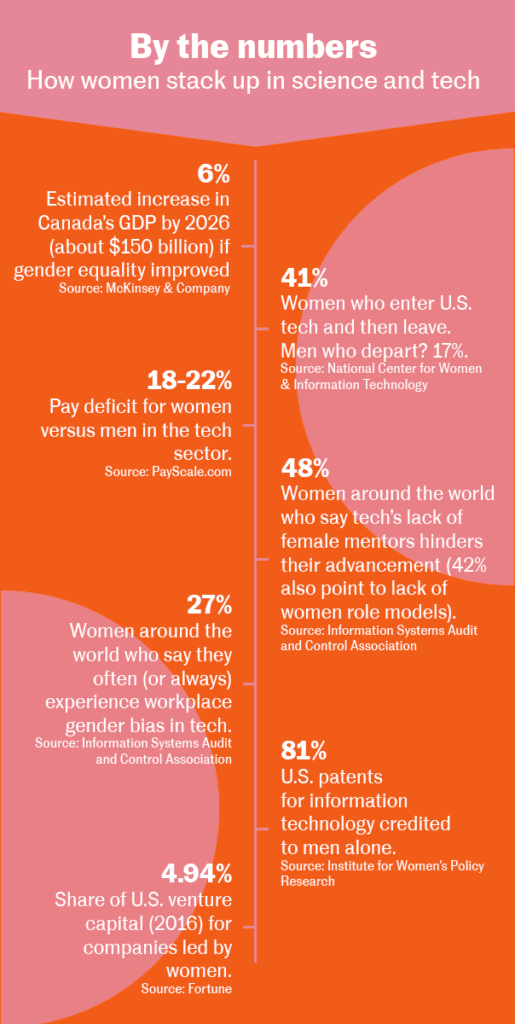
Silicon Valley is being hammered for failing to get a handle on its homogeneous culture. Four years after the giant tech companies started publishing their workforce diversity stats, the annual data dump has become a regular reminder of the glacial pace of change. Still, only about 20 per cent of tech jobs are held by women.
Meanwhile, as the #MeToo and Time’s Up movements have gathered steam, countless stories have emerged from the Valley of pervasive sexual harassment at tech companies and venture capital firms.
But Canada can’t afford to be too smug; our track record is not much better.
TD Economics reported last fall that women account for just one in five engineering graduates from Canadian universities, a figure that has not changed in 10 years. For computer science and math, the figure is one in four, an actual decline from a decade earlier. In 2016, men held 70 per cent of the 1,612 Canada Research Chair posts at universities across the country.
Why does this lack of young women studying sciences matter? Why does the tech world need diversity?
Eva Wong, co-founder and COO, Borrowell
Diverse teams, better products
Besides the moral argument for gender equality, the simple answer according to Kathryn Hume, vice-president of product and strategy for integrate.ai in Toronto, is that “a diverse workforce helps expand engineers’ perspectives.” Diverse teams are more likely to understand the full impact of what they’re doing and raise questions that would otherwise go unasked.
And the questions are many.
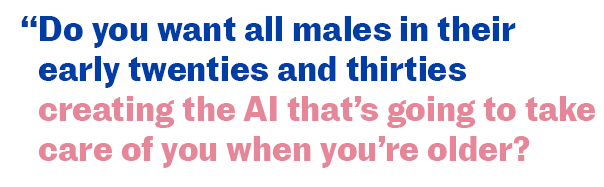
In the next few decades, artificial intelligence will reconfigure how we live, work and obtain services such as healthcare. But much of what’s happening is the product of brogrammer culture and, as tech philanthropist Melinda Gates pointed out in a recent interview, “Do you want all males in their early twenties and thirties creating the AI that’s going to take care of you when you’re older?”
Diversity is crucial, adds Eva Wong, co-founder and chief operating officer of Canadian fintech company Borrowell. Without strong female involvement, ventures can’t “understand or represent half the population.”
Gender bias creeps into technologies
The implications of a world lacking women in science and technology have already become apparent in healthcare.
Zayna Khayat, future strategist at St. Elizabeth Health Care, points out that women of child-bearing age have been historically underrepresented in drug clinical trials, which are usually conducted on Caucasian men.
“The reality is, women respond to drugs differently because of their biology, well beyond hormones,” she says. As a result, women have suffered disproportionately from side-effects from medications.
In other cases, women are simply forgotten. In 2014, Apple released HealthKit, which gathers medical data such as heart rate, exercise, sleep and body weight from personal apps and devices. The original version did not track the menstrual cycle, which makes it very difficult to evaluate a woman’s well-being properly. This feature has since been added.
Such mistakes are usually not intentional, says Hume, whose company envisions “a future in which AI enriches people’s lives while creating better, more valuable businesses.” Such biases creep into technologies because the people creating them aren’t aware of all the variables they need to consider, including factors related to gender.
Hume often talks to tech teams at large organizations about the ethics and fairness issues connected to machine-learning algorithms, and says programmers sometimes don’t realize how bias can sneak into their work. “They’re like, ‘Oh, god, I didn’t even think about that,’” she says.
No more sidelines: We need “all hands on deck”
As the world faces an array of urgent issues—from climate change and the ever-growing needs of the elderly to the wave of disruption that technological advancement is bringing to the workforce—it’s more vital than ever to bring the best talent and broadest range of perspectives to bear.
“We can’t afford to have women on the sidelines,” says Ilse Treurnicht, the Oxford-educated research chemist and venture capitalist who spent 12 years as chief executive officer of MaRS Discovery District in Toronto.
Treurnicht believes that solving these problems will take an unprecedented degree of innovation and collaboration. The decisions made now will have ramifications that could last for generations. Having women play the role they deserve increases the likelihood that tech leaders will be less motivated by self-interest than by “what’s best for our kids and our community—and our planet.”
She adds: “We need a really different approach, with all hands on deck. It’s way too important to leave all this to men.”
Despite women’s impressive gains in education and the workplace over the past 50 years, men greatly outnumber women in leadership, especially in top positions. Barriers and Bias: The Status of Women in Leadership delves into the reasons for these leadership gaps and proposes concrete steps for narrowing and, ultimately, eliminating them.
There is strong evidence that organizations with gender diverse boards and senior leadership are more likely than their counterparts to yield stronger financial results in the long term, and to enjoy a more positive and empowering organizational culture.
This Playbook serves as a thought-starter and provides practical tools for action that result in improved gender balance on boards.
New research has some answers — and what we can do about it.
Nobody was going to stop her. Nobody. Certainly not the other students who might make fun of her for raising her hand in class, repeatedly, to ask questions. It was eighth-grade math, and it was hard. She asked the teacher a question. And then another. And then another. Every class, the drill was the same: Wash, rinse, repeat.
Microsoft CFO Amy Hood speaks to female students at Franklin High in Seattle on International Women’s Day, Thursday, March 8, 2018.
(Photo by Dan DeLong)
“People used to even make jokes about me because I asked so many questions,” says Kennedy Sampson, now a high school junior in Maryland. “But I needed to understand it …I had to do what I had to.”
Kennedy’s determination and grit makes her a good candidate to succeed in math.
Her voice was among more than 6,000 U.S. girls and women from ages 10 to 30 who were interviewed for a newly released study about STEM (science, technology, engineering and math) education. The study, done by Microsoft in partnership with KRC Research, finds that despite the high priority that is placed on STEM in schools, efforts to expand female interest and employment in STEM and computer science are not working as well as intended. This is especially true in technology and engineering.
While the U.S. Bureau of Labor Statistics predicts that technology professionals will experience the highest growth in job numbers between now and 2030, only a fraction of girls and women are likely to pursue degrees that enable them to fulfill these news jobs.
Inspirational sticky notes found at Microsoft Studio C were started by Jamie Cabaccang, a senior design lead, to help women on her team feel a sense of community. They began to spread across Microsoft’s Redmond campus quickly this week.
The reasons range from peer pressure, to a lack of role models and support from parents as well as teachers, to a general misperception of what STEM careers look like in the real world. But the research also points to ways to better support girls and young women in STEM. Those include:
Providing teachers with more engaging and relatable STEM curriculum, such as 3D and hands-on projects, the kinds of activities that have proven to help retain girls’ interest in STEM over the long haul. (“My teacher’s making me build a rocket ship with some other students, so that got me interested in STEM a little bit because I like to build and create,” says one middle-school girl interviewed for the study).
Increasing the number of STEM mentors and role models – including parents – to help build young girls’ confidence that they can succeed in STEM. Girls who are encouraged by their parents are twice as likely to stay in STEM, and in some areas like computer science, dads can have a greater influence on their daughters than moms, yet are less likely than mothers to talk to their daughters about STEM, the study found. (“I grew up with my mom always encouraging me to learn more, an engineer dad and a chemist grandpa, both of whom were always excited to answer my questions, support and teach me,” says a 27-year-old woman interviewed for the study.)
Creating inclusive classrooms and workplaces that value female opinions. It’s important to celebrate the stories of women who are in STEM right now, today. (“It’d be really cool to see women in STEM careers on posters in the hall, in our history and science texts, and visit our classes,” says a 14-year-old girl who is in eighth grade. “I don’t know what to focus on. But my tests say I’m a good engineer and I wish I knew what that looked like in real life.”)
Although a college professor tried to discourage her from pursuing a career in engineering, and there were other stumbling blocks along the way, Peggy Johnson says her mother encouraged her to “stick with it” during the “challenging ups and downs of pursuing my engineering degree.”
Peggy Johnson, an engineer who is now Microsoft’s executive vice president of business development, didn’t know what being an engineer looked like – until she got to college. She began college as a business major. She was a freshman, doing a job delivering campus mail, when she took some packages to the engineering department – and everything changed.
“The two ladies behind the desk there got super-excited when they saw a woman walking in, because they thought I was going to ask questions about engineering, but I wasn’t,” Johnson says. “I was just delivering the mail, I couldn’t understand their excitement. And they talked to me about engineering, opening up the world of what an engineering degree could do for me. They said in engineering, you can work on the world’s biggest problems and help solve for them.”
That evening, Johnson thought about what the women had said. The very next day she changed her major to engineering.
Her parents backed her choice. “It was really my mom, who had grown up in a different time, when many women didn’t go to college, who said, ‘I think it’s going to be a fantastic career for you!’ because she’d seen me love math and science all those years.”
Her mother encouraged her to “stick with it,” during the “challenging ups and downs of pursuing my engineering degree,” Johnson says. The “downs” included a professor who tried to discourage her from continuing on in her major.
“I was an electrical engineering major, but I had to take a few classes in mechanical engineering. For whatever reason, I wasn’t as skilled in that field, so I struggled. I went to talk to the professor several times. And he said, ‘I just don’t think this is the right degree for you.’”
He “almost convinced me,” she says. But her mother told her differently, yet again. “I know you’ll stick with it” – and Johnson did.
Franklin High students Jill Kumasaka, center, and Julie Pham, right, laugh as Microsoft CFO Amy Hood speaks to female students at the Seattle school on International Women’s Day, Thursday, March 8, 2018. (Photo by Dan DeLong)
Sticking with it is something girls need to be encouraged to learn, says Reshma Saujani, founder and CEO of Girls Who Code, whose mission is to close the gender gap in technology. It is among the many STEM nonprofits supported by Microsoft Philanthropies.
“We have to rethink the way we raise our girls,” Saujani says. “Boys are pushed to take risks; girls are not. In fact, they feel like they have to be perfect at everything they do; they see getting a ‘B’ in math class as bad.
“We have to teach girls to be imperfect.”
When it comes to computer science, “The process of learning how to code is learning how to fail,” Saujani says. “We need to teach girls that it is all right to sit with that discomfort of not knowing the right answer right away.”
She also emphasizes how important it is to have a dad that “doesn’t coddle you, that encourages you to try new things. You have to inspire girls to try things that they may not be good at,” she says.
John Sheehan, a Microsoft Distinguished Engineer, says he has always encouraged his daughter Kaley’s interest in math. Sheehan volunteers and mentors other girls to pursue STEM educations. (Photo courtesy of John Sheehan)
John Sheehan’s daughter has always been good at math, but even so, he saw her being discouraged in classes, albeit it indirectly.
“I used to go to her schools, for the parent-for-the-day activities, and I remember math teachers praising the boys” regularly, but the girls – not so much.
That wasn’t acceptable to Sheehan, a Microsoft distinguished engineer. While his daughter didn’t say she felt disheartened, at times he sensed she was.
“She’d say, ‘Oh, this math is hard,’ and I’d say, ‘Yeah it’s hard for everybody – but you can do it.’ There was this sort of underlying feeling society was telling her that boys are better at math. It made her think when she had trouble with some particular topic, it might have something to do with the fact that she was a girl. My job as a parent was to dispel that belief.”
Sheehan is among the Microsoft employees who volunteer to educate girls about computer science and STEM. He also started a fund for girls and STEM at his alma mater in Boston.
“It’s critical to mentor girls from classroom to the boardroom, across the full career continuum in STEM,” says Toni Townes-Whitley, Microsoft corporate vice president for industry.
Toni Townes-Whitley, Microsoft corporate vice president for industry, had a similar experience in school, like Johnson and Sheehan’s daughter. A high school chemistry teacher of hers was “partial to my male counterparts,” and “did not encourage girls to pursue ‘hard’ sciences.”
Townes-Whitley did not let it stop her.
“Once I recognized the bias, I made it a point to connect with the other female students, study together and outperform collectively in the class,” she says.
That spirit of determination continues in her current role. “It’s critical to mentor girls from classroom to the boardroom, across the full career continuum in STEM,” she says. “The research has indicated that there are ‘off ramps’ at different educational levels where girls leave STEM programs throughout middle school, high school and undergraduate” in college.
“It’s important to encourage, inspire and support to stay the course, and present STEM careers differently.”
Mary Snapp, corporate vice president and head of Microsoft Philanthropies, agrees. “Unless things change much faster, many in this bright, hopeful generation will not enter these fields,” she wrote in a recent post. “These are among the reasons Microsoft Philanthropies provides grants to nonprofits that prioritize increasing diversity in computer science, and more than half of beneficiaries are female.”
Snapp adds that Microsoft commissioned the research to better understand what causes girls and young women to disengage from STEM studies, what can be done to fix the problem and to share those learnings with others.
Helen Chiang, general manager of Minecraft Franchise, says both her parents encouraged her early interest in STEM. When she was in middle school, her mother drove her to the local high school “each day so I could take upper-level math and science with the high schoolers.”
When Chiang wasn’t feeling challenged enough in her regular high school curriculum – and was “considered an oddball/nerd/geek by the rest of the class because I excelled in math and science” – her parents stepped in yet again.
“They supported my passion and interests by finding me a math and science high school program so I could learn and be challenged in an environment with other kids like me,” she says, noting: “It’s incredibly hard to be an outlier, especially during the teenage years.
“Learning in a community of peers that had similar interests kept me from leaving STEM early because it wasn’t considered popular in my regular high school.”
“I have two young daughters, so I am incredibly motivated to ensure they grow up in a world where they can grow up to be anything they want to be,” says Helen Chiang, general manager of Minecraft Franchise. “I hope they never run into some of the situations I have faced.”
Chiang says where she grew up, “It wasn’t popular for girls to be smart or interested in challenging subjects within STEM. I went through a period of wondering whether I should pretend to not understand subjects, or dumb myself down so that I would be liked. I have to credit my parents, who reinforced in me from an early age that it’s much more important to always be curious, always be learning and continue to challenge yourself – than to want to be liked. Friends and popularity come and fade, but what’s in your brain should stay with you a lifetime.”
Peggy Johnson can vouch for that. After she graduated college, she went on a job interview with a company that was based in another country.
“I don’t think they knew that Peggy was a female name,” she says. “And I walked in the door, and I sat down, and the interviewer looked at me and said, ‘Oh, why are you here?’ I said, ‘You posted this engineering job.’ And he said, ‘Oh, we don’t hire female engineers.’ And then he got up and left.”
Johnson remembers looking at the walls around her and thinking, “Well, I guess this interview is over.”
She picked up her resume and walked out, not letting that setback defeat her. Soon, that company’s loss would be Qualcomm’s, and later, Microsoft’s gain. And in 2017, Johnson was ranked No. 1 as the most powerful female engineer in the U.S. by Business Insider.
Lead Photo: Student Jill Kumasaka talks about STEM issues during a Franklin High School session with other female students, where Microsoft CFO Amy Hood spoke on International Women’s Day, March 8, 2018. (Photo by Dan DeLong)
Mary Snapp, corporate vice president and head of Microsoft Philanthropies, agrees. “Unless things change much faster, many in this bright, hopeful generation will not enter these fields,” she wrote in a recent post. “These are among the reasons Microsoft Philanthropies provides grants to nonprofits that prioritize increasing diversity in computer science, and more than half of beneficiaries are female.”
Snapp adds that Microsoft commissioned the research to better understand what causes girls and young women to disengage from STEM studies, what can be done to fix the problem and to share those learnings with others.
Helen Chiang, general manager of Minecraft Franchise, says both her parents encouraged her early interest in STEM. When she was in middle school, her mother drove her to the local high school “each day so I could take upper-level math and science with the high schoolers.”
When Chiang wasn’t feeling challenged enough in her regular high school curriculum – and was “considered an oddball/nerd/geek by the rest of the class because I excelled in math and science” – her parents stepped in yet again.
“They supported my passion and interests by finding me a math and science high school program so I could learn and be challenged in an environment with other kids like me,” she says, noting: “It’s incredibly hard to be an outlier, especially during the teenage years.
“Learning in a community of peers that had similar interests kept me from leaving STEM early because it wasn’t considered popular in my regular high school
Many companies continue to struggle with advancing and retaining women. One company, BCG, discovered that the gender disparities in their senior cohorts were not completely explained by traditional concerns such as work-life balance or differential ambitions. Instead, they identified a very different explanation: the quality of the day-to-day apprenticeship experience. Apprenticeship – the working relationships of junior team members learning alongside experienced colleagues – is how employees develop critical skills and leadership capabilities. With this insight, they launched a new program to focus on stronger work relationships, strengths-based development, and coaching for a range of communication styles. Five years into it, their promotion rates for women have increased by 22 percentage points among senior managers; the retention of women in mid-career levels is now at parity with that of men; and satisfaction with BCG’s efforts to retain women has increased by 20 percentage points for all women and by 30 percentage points for senior women. Based on these results, they recommend three actions for any company talent-driven company: Embed apprenticeship into the delivery of core products and services; prioritize and monitor relationships at work; and encourage diverse strengths and styles.
Many companies continue to struggle with advancing and retaining women. As we’ve studied our own progress at BCG, we have found that gender disparities in our senior cohorts are not completely explained by traditional workplace concerns, such as work-life balance, maternity leave, unequal pay, and differential ambitions. We have identified a very different explanation, which is just as critical: the quality of the day-to-day apprenticeship experience.
Apprenticeship, the working relationships of junior team members learning alongside experienced colleagues, is critical to mastering the consulting craft and succeeding in professional services. It’s a model that’s increasingly used in companies of all kinds looking to accelerate the development of their high-potential people. Management consulting is a challenging environment in which to cultivate apprenticeship, because staff regularly jump from project to project and manager to manager. As in many fast-paced companies today, consulting staff operate without formal job descriptions or handbooks. So relationships are where employees develop critical skills and leadership capabilities.
However, when we analyzed the annual employee survey data specifically for high-potential, mid-career women who regrettably left the firm, we found the lowest scores were around the statement “I am satisfied with the apprenticeship and feedback I received.” Moreover, in a survey of employees leaving BCG, departing women ranked mentorship, not work-life balance, as the number one topic that the firm needs to improve on. Finally, in a survey of all North American staff, asking about 16 options of what people seek from a manager, “forming a strong relationship with my manager(s)” and “having someone in leadership who cares about me and reached out long after the project ended” were the most valued dimensions for women.
Equipped with this data, BCG teamed with leadership development consultancy BRANDspeak to launch a bold transformation across North America: Apprenticeship-in-Action (AiA). The AiA program focuses on the three components of apprenticeship that drive satisfaction and retention: relational connectedness, strengths-based development, and coaching for a range of effective communication styles — levers that are relevant to any manager who strives to get the best from individuals and teams.
Five years into the journey, we have seen remarkable improvements. Female promotion rates have increased nationwide across all cohorts, with a 22-percentage-point rise among senior managers, while the attrition of senior women has slowed by five percentage points. Retention of women in mid-career levels is now at parity with that of men. Satisfaction with BCG’s efforts to retain women has increased by 20 percentage points for all women and by 30 percentage points for senior women.
While it would be difficult to attribute all of this improvement directly to AiA, we believe it is a clear driver. Here’s why.
Improving Connectedness
Our research found that both genders, but particularly women, viewed many work relationships as transactional. To remedy this, AiA equipped managers to be more deliberate about investing in relationships, focusing on four elements: (1) making personal connections, (2) investing in individuals’ success, (3) guiding and advising, and (4) staying in touch between projects. We gave tactical suggestions for how managers could do this (e.g., use travel time to connect with team members and establish an open-door policy). We also reinforced connections through mentorship and sponsorships.
Since the program’s rollout, the firm has seen a nine-point improvement across both genders for those who report having a manager that proactively coached and developed them in their first year. One male partner shared that he now tracks check-ins with teammates on his to-do list and spends time “making sure they are meaningful conversations.” A female partner commented, “Now I’m vocal about the importance of having a personal connection, and someone who is invested in and is watching out for you.”
Using Strengths-Based Development
Our research showed that 63% of BCG staff across all levels and genders felt that our feedback focused too heavily on areas for development.
To address that, AiA introduced training and tools to enable managers to ground personal development in an individual’s differentiating strengths by creating a strengths inventory and linking each strength to a specific area for development. This allows people to leverage their strengths to accelerate improvement. For example, instead of telling someone who is quiet that they need to speak up in meetings, we may highlight their ability to extract insights out of analysis and suggest they think about what insights to share at the next meeting. This linkage has enabled a powerful transformation in the way managers and advisors give feedback and coach. One female consultant reflected that “understanding how my core strengths can help me to address my development areas and propel me forward in my career is much more helpful than focusing solely on where I need to improve.”
Training around leveraging strengths has contributed to an 18-percentage-point drop in the number of senior managers who think that feedback centers excessively on development areas. One male senior partner said, “Personally, I had my own philosophy about how to give feedback, but AiA has evolved it.” The female senior partner who leads the firm’s career development process commented, “We’ve introduced an entirely new vocabulary into our apprenticeship model. Our old rubric was that you’re ‘missing something.’ Now we’re looking for linkages between strengths and development areas, and all our written and verbal communication reflects that.”
Acknowledging a Range of Effective Communication Styles
As with many workplaces, BCG has traditionally operated according to male communication norms. Before AiA, women reported receiving feedback from managers to “be more aggressive” or “take up more space,” advice viewed by many women as ineffective or inauthentic (among other reasons, it’s difficult for a five-foot-tall woman to internalize how to take up space). BCG recognized that many talented leaders, particularly women, have strong communication skills that differ from the dominant style. The most effective communicators span a range of styles and tailor their approach to fit the audience.
AiA acknowledges the importance of communication range and has pioneered a new, comprehensive training, which includes coaching around “building rapport” and “reading the room.” More women and men now see a range of styles as being necessary to navigate diverse situations. Coaching helps individuals identify where they have gaps in their range and develop new skills. For example, while coaching previously focused on delivering tough messages and landing a point of view, today we are focused on facilitating two-way dialogues and building connectivity. This portion of the program is in the early stages, but the firm has already seen an eight-percentage-point decrease in the number of people who report that their own communication style is different from that of successful BCG employees. One male partner noted, “I’m much more careful of not trying to force-fit everyone to be like me.” Similarly, a female partner reflected, “Before AiA, the fights in career reviews were insane. Now I hear, ‘She needs to be more aggressive,’ and I hit the pause button and ask the room, ‘What if she doesn’t want to be more aggressive?’”
Reflecting on our five-year journey and the results we have achieved, we recommend three actions for any company in which talent management defines competitive advantage:
Embed apprenticeship into the delivery of core products and services. Identify a model that develops the talent you need and resonates with the diverse set of individuals you employ, and embed it: Make it part of training, professional development, the way managers are coached and evaluated. Monitor the impact — are your employees more satisfied on key dimensions? Are you retaining more top talent? As a leadership team, take ownership for addressing individuals and behaviors that don’t meet the target model.
Prioritize and monitor relationships. Build opportunities for relationships to develop and flourish. Incentivize leadership to invest in relationships and monitor their effectiveness. For high-performing talent and underrepresented groups, ensure they have performance-enhancing relationships at all levels. Collect information from individuals on which work relationships they consider their strongest, so you make sure there is someone who is supporting key talent.
Encourage diverse strengths and styles. A lot of organizations state that they want people with diverse backgrounds on their teams — but then coach people to behave uniformly. A truly diverse organization that reaps the benefits of diversity, better serving customers or clients in different situations, needs to value a range of communication and working styles. Feedback needs to build on the differentiating strengths of the individual, rather than their weaknesses.
BCG is in the process of implementing the AiA model beyond North America, aspiring to a global rollout. We also have plans to introduce AiA to other companies through our client work. And while originally designed with a gender focus, the program has benefited both men and women, with broader applicability to other diversity networks, including ethnic diversity, LGBT employees, and veterans.
We recognize that we have further to go before we reach our ambition of gender parity. Nonetheless, our experimentation offers a rare example of long-term progress on diversity goals. Results to date make us optimistic that transforming the day-to-day apprenticeship experience is fundamental to improving the satisfaction, retention, and advancement of our diverse workforce.
A guide that was developed to help parents and families, formal and information educators, and community role models for girls and young women learn how to encourage and inspire girls from birth to adulthood to explore the world around them. The guide also gives you tools to motivate and expose girls to experiences to develop STEM skills and build confidence in their abilities so they will be prepared to pursue STEM careers.