















Ada Lovelace Day (ALD)
Ada Lovelace Day (ALD) is an international celebration of the achievements of women in science, technology, engineering and maths (STEM). It aims to increase the profile of women in STEM and, in doing so, create new role models who will encourage more girls into STEM careers and support women already working in STEM.
Founded in 2009 by Suw Charman-Anderson, it is now held every year on the second Tuesday of October. It features a flagship Ada Lovelace Day Live! ‘science cabaret’ event in London, UK, at which women in STEM give short talks about their work or about other women who have inspired them, or perform short comedy or musical interludes with a STEM focus.
Find out more here
Based in the Bay Area, AWIP was founded in 2017 to address the gaps they saw in tech management roles that were filled by women and other underrepresented groups.
Find out more here
Leadership development for women in STEM. CCL’s customized services allow organizations to develop the leadership competencies and culture needed to meet specific challenges and business realities.
Find out more here
Diversity in science refers to cultivating talent, and promoting the full inclusion of excellence across the social spectrum. This includes people from backgrounds that are traditionally underrepresented and those from backgrounds that are traditionally well represented.
Why does diversity matter in science?
Read Article: https://blogs.scientificamerican.com/voices/diversity-in-stem-what-it-is-and-why-it-matters/

Mandy Kovacs
@mandyvkovacs
Published: March 8th, 2017
At first glance, award-winning film Hidden Figures seems like your typical Oscar-nominated movie: great plot, superb actors, eye-catching visuals, and an inspiring story. But there’s more that meets the eye.
Based on a true story, Hidden Figures chronicles the lives of three women working at NASA in the 1960s during the space race between the U.S. and the Soviet Union. The struggles they faced, both as women and as people of colour, in the male-dominated industries of science, technology, engineering, mathematics, and computer science (STEM), is something that continues to this day.
Globally, women account for less than a third (28.4 per cent) of those employed in scientific research and development, according to a report published in November 2015 by the United Nations’ Educational, Scientific, and Cultural Organization’s (UNESCO) Institute of Statistics. They are also more likely to leave their roles in STEM fields, with a majority of women citing isolation, hostile male-dominated work environments and a lack of effective sponsors as the reasons behind their decision, says a Harvard Business Review research report.
In Canada specifically, while women represent the majority of university graduates (59 per cent in 2011), they are still underrepresented and less likely to choose a career in STEM fields. Statistics Canada reported at the end of 2015 that women accounted for just 39 per cent of university graduates aged 25 to 34 with a STEM degree, compared to 66 per cent of graduates in non-STEM programs.
The majority of those female STEM graduates were concentrated in science and technology programs (59 per cent), but only accounted for 23 per cent of those who graduated from engineering programs and 30 per cent of mathematics and computer science programs.
However, the women currently in STEM fields are working hard to change this.
Keep the discussion going
The best way to encourage more women to go into STEM industries is to keep drawing attention to it, says Margaret Dawson, global product marketing manager at Red Hat Inc., a U.S.-based open-source enterprise software company.
“People often say we’re talking too much about this topic, but I completely disagree,” she tells IT World Canada. “Yes, women have made amazing advancements and I’m so incredibly proud at how far we’ve come, but look at the statistics; things have not changed all that much. Until the disconnect between women and STEM is bridged, we still have more work to do.”
Expanding on this is Norrie Davidson, CEO of Third Octet Inc., a Toronto area-based technology solutions provider.
“Visibility is the best way to encourage people and specifically women, to go into the STEM field,” she states.
Davidson points to movies like Hidden Figures as a great start to raising more awareness, but adds that more mediums need to be used.
“There needs to be more discussion on social media about the lack of women in STEM. People should be tweeting about this, making videos on YouTube about it, posting on Facebook, the works,” she says. “And not only should we be talking about it, we should also be showcasing what working in these fields is like, what can be accomplished, and even how much money can be made, to entice women and show them what kind of an impact they can have.”
But why is this important? According to Statistics Canada, having more women in STEM programs and jobs can be directly linked “to a country’s competitiveness and economic prosperity.”
“STEM graduates are considered key inputs of the national innovation system,” the Canadian agency says. “At the individual level, previous reports have also suggested that a STEM degree would lead to better labour market conditions and higher earnings, especially for those with a background in engineering and computer science.”
Affirmative action
Within the STEM field itself, Dawson believes there needs to be improvement made to the hiring process. She says that, while controversial to many people, the intentional hiring of women is one answer to increasing numbers that makes sense.
“I get a lot of negative feedback for this opinion because it sounds very biased and unfair, but I don’t mean it in the sense that a company should hire a woman over a man when the woman is less qualified. I’m talking about when there’s a job opportunity and both the men and women who applied have the same experience and qualifications and it comes down to a proverbial coin toss,” she explains.
“Diversity is important – and not just gendered diversity, I’m also talking about different backgrounds, religion, skin colour, everything – and in business, having a diverse set of employees, executives and board members with different life experiences and opinions, generally makes a company stronger.”
Luc Villeneuve, general manager at Red Hat Canada, has been a champion of women in STEM throughout his 30-year career in the tech industry and often goes out of his way to seek out women candidates for job opportunities.
“When I interview people for jobs, the pool of candidates on the female side is usually so small, I extend the application deadline or get in touch with people in my network to see if they have any women they think would be a good fit for the position,” he says. “It doesn’t mean they’ll be the best or that I’ll offer them the job, but I do believe it’s important to at least begin the hiring process with a variety of options and offer equal opportunity.”
But Villeneuve doesn’t just talk the talk. He tells IT World Canada that he’s actually replaced himself three times in three different executive roles with women he knew were better qualified and would do a better job than him. And just three years ago, Red Hat Canada did not have a single female account manager, but under Villeneuve’s leadership, women now make up 25 per cent of the company’s account managers. While he is adamant he won’t be satisfied until that number is at 50 per cent, he admits that he’s happy with how far the company has come in such a short amount of time.
“It’s about leading by example. There are a lot of people that say the right things, but it’s their behaviour and actions that really count.”
Paving the way for future generations
Beyond hiring, the industry needs to do a better job of reaching young women both still in school and those just beginning their careers in STEM, Third Octet’s Davidson says.
“We all, both males and females, need to step up to the plate and provide more leadership and mentorship to the younger generation coming through. Having role models and a support system of people that believe you can do something is incredibly valuable,” she points out.
Another company walking the walk is IBM Corp., which played a role in Hidden Figures (and in the wider world) through its IBM 7090 electronic computer and Fortran programming language. The company partners with Girls Who Code and Ladies Who Code, non-profit organizations dedicated to reducing the gender gap in the technology industry, to run camps and programs aimed at engaging girls and young women in the STEM field.
IBM also has an internal mentor program that allows its personnel to learn skills from other employees.
“IBM does some great things in terms of education: in addition to the coding camps we run, we also bring in kids between grades six and nine to talk about technology and expose them to activities they’d be doing if they ended up in STEM,” Victoria Odeyemi, a software engineer at IBM, tells IT World Canada. “And at the university level, we have open houses, class demonstrations and guest speakers.”
However, Odeyemi points out that when talking about attracting women to STEM jobs, there’s no right age.
“It’s never too late and we need to keep coming up with ways to target women of all age groups and show how they can enter STEM professions,” she stresses. “Even when women want to change careers at the age of 30, we need to include them in this discussion. We need to focus on young people, but also not forget about the older ones. Many people going into school are not sure of what they want to do, so this would be the time to reach out to women of all ages.”
Changing mentalities
Starting early with education is key, but so is changing existing mentalities, according to Cathy Vankesteren, senior vice president of End to End Networks Inc., a data, network and security infrastructure provider and technology advisor based in the Toronto region.
Men are good at promoting themselves, but women tend to lack in this area and it hurts their ability to find and obtain jobs, she explains. Vankesteren points to a recent job day End to End networks held in conjunction with George Brown College in Toronto, which gave a selected eight students the opportunity to see how the company worked, as well as participate in presentations, labs and technical tests, for a potential chance at an internship. One of the two chosen women participants was technically strong and gave an excellent presentation about smart cities, Vankesteren says, but failed to introduce herself.
“This one girl was clearly very intelligent and experienced, but she didn’t introduce herself in the beginning and more importantly, we had to probe her to offer up any personal information; we had to pull it out of her,” Vankesteren says. “At any potential internship or job interview, selling yourself is very important and this experience made me realize that we as an industry are not doing enough to build the confidence and educate these young women in terms of the skills they need to get new jobs and promotions.”
She is convinced that starting early in schools and teaching such skills would have dramatic effects on the number of women in STEM going forward, a statement echoed by Red Hat’s Villeneuve.
“My passion for advancing women started early on growing up with great role models like my grandmother, mother and two sisters, and I believe we need to start instilling these values in men as early as possible,” he says. “If male leaders already in the industry don’t see how important women participation in STEM is or women leadership is in general, it’s probably too late. We need to train men on how important diversity is as early as possible, not after 30 years in the business, and hopefully that will kickstart a trend that can continue to build over time.”
But Fariba Anderson, CEO at AcuteNet Inc., a software solutions provider in the Toronto area, says that changing perspectives is just as important.
“Us women need to start looking at our situations from a glass half full perspective. There’s the perception that we haven’t achieved enough, and while there are still things holding us back, that’s sort of a conceded attitude,” Anderson says. “We focus more on what we don’t have instead of what we do have, and that conversation needs to change.”
She says celebrating what has already been achieved, as well as advocating and supporting other women are two positive things that can be encouraging for the next generation. Anderson uses Verity, a Toronto-based women-only club, as an example of women promoting women.
“Verity is a centre for women of all walks of life to come together and discuss their experiences, network with others and just generally, advance women and women leadership. But we hear so many excuses about how women don’t have time to join, or it’s too far for them or its too expensive, but they have time to say we’re not advancing? There’s an irony in there that I’m not sure if I’m conveying,” Anderson explains. “We need to promote ourselves better, network better, support each other better, and places like this are a great place to start.”
A not so lonely path to the top
While advancing women in STEM obviously starts with women, Anderson continues to say that it’s not a job they can or should do alone.
“Women need to challenge men leaders, whether in big or small companies, to make a statement about gender diversity. We need to take ownership over our own advancement, but we also need help,” she says. “I’m a huge proponent for featuring people like Luc [Villeneuve] because we need men like him on our side, and we need collaboration from the whole team to make a difference.”
Third Octet’s Davidson also mentions something similar while talking with IT World Canada. She believes opening up and including men, or at least the ones who want to be involved, is the key to success.
“Sometimes as women, we create this sense of isolation, like it’s us against the world, but it doesn’t have to be that way. So many men are looking over at us wanting to know what’s going on and wanting to help in any way they can,” Davidson says.
“Just as we need to find opportunities to communicate with younger women, we need to find opportunities to communicate with men and get them involved so they can understand what we’re dealing with and what we want.”
SOURCE: https://www.itworldcanada.com/article/lets-talk-about-women-in-stem/391215

Visual control of a solar panel within the production process on August 01, 2017 in Frankfurt an der Oder, Germany.
(Photo by Thomas Koehler/Photothek via Getty Images)
Women in the technology and Engineering fields are not less qualified but are disproportionately placed in lower, non-professional roles in Canada, according to a new report.
The report Women and STEM: Bridging the Divide, released by TD Economics on Sept. 12, focused on how far women have come in Science, Technology, Engineering and Math (or STEM) fields.
The report says STEM fields could play an integral part in bridging the overall wage gap since it offers higher incomes compared to other occupations.
But only one in five people graduating from engineering programs in universities are women – which is nearly identical to the statistics from 10 years ago.
In computer science and math, one in four people graduating with degrees are women, a statistic that’s actually worse than those of 20 years ago.
“Girls and women appear to face many layers of systemic bias throughout their career progression within the STEM field,” the report states.
STEM roles can be sorted into professional and technical jobs, where female professionals make between 30 to 37 per cent more than a woman in a technical role.
TD found that women with bachelor degrees in a STEM field were more likely than men to have a technical role instead of professional — 30 per cent of technical roles are women with a bachelor’s degree, while 21 per cent of roles are men with similar degrees.
But it also found that women with master’s degrees in a STEM field didn’t have this problem, or at least it wasn’t as bad. (78 per cent of women in STEM with a master’s degree held a professional role, compared to 84 per cent of men.)
While the extra degree improves a women’s chances at a professional role, “this silver lining is tainted if women perceive this to be a necessary step in order to mitigate the occurrence of ‘occupational sorting,’” TD explains.
But it offers up some solutions.
“Everyone has a role to play in reducing educational and labour market friction,” the report states.
Employers are urged to take a look at hiring practices, and check for occupation sorting and wage disparity. Parents and educators are urged to encourage young girls to explore STEM fields.
The report was released after wide media coverage of a former-Google employee was fired after slamming his company’s diversity policies in an internal memo. James Damore argued that the gender gap in the tech sector can be blamed on inherent differences between men and women, leading to widespread criticism from activists around the globe. Damore was fired for his comments, which violated the company’s code of conduct, Google CEO Sundar Pichai explained.
SOURCE: https://globalnews.ca/news/3739338/women-stem-lower-paying-jobs/
Following OSPE’s recent announcement of receiving funding from Status of Women Canada (SWC) for its Canada 150 Challenge: Overcoming Barriers for Women Choosing Science, Technology, Engineering and Math (STEM) Careers proposal, OSPE has received requests for examples of what specific barriers women face when it comes to entering, remaining or exceling in the engineering profession. Some major barriers are listed below, along with findings and statistics from surveys and reports that OSPE and other organizations have conducted.
Getting more #WomeninSTEM is not a new initiative – it has been a focus of post-secondary institutions, the private sector, governments and not-for-profits across North America for more than a decade. Why? Because as science, technology and engineering innovation continue to transform society as we know it, everyone will need a wider range of skills to compete. In order to remain competitive, Canada and other countries must ensure that more young people, including women, are pursuing careers in STEM, and that once they have that education, STEM careers remain attractive to them. That’s why so many initiatives have been underway for years to address “barriers”.
1. Cultural bias and discrimination
STEM organizations and institutions across North America and beyond have been conducting studies to find out why women are increasingly prominent in medicine, law and business but not science and engineering. In 2006, the US National Academies of Science, Engineering and Medicine joint committee on “Maximizing the Potential of Women in Academic Science and Engineering” conducted a report entitled Beyond Bias and Barriers: Fulfilling the Potential of Women in Academic Science and Engineering.
The study identified that “women are very likely to face discrimination in every field of science and engineering” and that a lack of action to correct this and other issues will be “detrimental to the nation’s competitiveness”.
From the report: “Considerable research has shown the barriers limiting the appointment, retention, and advancement of women faculty. Overall, scientists and engineers who are women or members of racial or ethnic minority groups have had to function in environments that favor—sometimes deliberately but often inadvertently—the men who have traditionally dominated science and engineering. Well-qualified and highly productive women scientists have also had to contend with continuing questioning of their own abilities in science and mathematics and their commitment to an academic career. Minority-group women are subject to dual discrimination and face even more barriers to success. As a result, throughout their careers, women have not received the opportunities and encouragement provided to men to develop their interests and abilities to the fullest; this accumulation of disadvantage becomes acute in more senior positions.”
Here at home, researchers at the University of Western Ontario and the University of Toronto partnered with OSPE to conduct a Changing Workplaces online survey of Ontario engineers in 2016-17. With more than 600 respondents, over half of the women who completed the survey (51%) reported being discriminated against in their workplace. A large majority of men (85%) reported having no discrimination directed towards them.
Individuals and initiatives working to change cultural biases and discrimination in engineering have popped up online and in the news frequently over the years.
- Another video of interest: The #ILookLikeAnEngineer campaign made headlines for its efforts to break gender stereotypes in the field of engineering.
2. Lack of mentorship in early stages of career
Before beginning its Engineering Professional Success pilot mentorship program in partnership with the Ontario Network of Women in Engineering (ONWiE), Professional Engineers Ontario (PEO), PEO York Chapter, and the Canadian Centre for Women in Science, Engineering, Trades and Technology (WinSETT), OSPE conducted a needs assessment survey in February 2015 which was completed by 1,566 engineering students who were about to graduate, as well as Engineering Interns (EITs) and professional engineers from across the province.
A vast majority (97%) of female respondents thought mentorship was important when starting an engineering career after graduation. About two-thirds agreed that mentoring improves women’s career prospects and retention in the engineering profession. The research also provided a clear sense of women’s priorities and the hurdles they must overcome in the early stages of their careers.
Survey respondents listed the following as the top challenges they face:
- Weak professional network
- Inadequate on-the-job training or professional development opportunities
- Underutilized engineering skills
- Work culture and job demands that compete with family and/or community responsibilities
- Fewer opportunities for field work than colleagues
- Feeling disrespected and undervalued by managers and/or co-workers
As a result, OSPE designed a pilot mentorship program to reflect the needs of both International Engineering Graduates (IEGs) and Canadian Engineering Graduates (CEGs). Through the creation of 90 mentoring relationships, protégées (mentees) reported that the pilot program was “incredibly valuable”, allowed them to make “wiser career decisions”, created a “renewed passion” for engineering, and “inspired me to stand up for myself”.
OSPE will be continuing its mentorship program and is pleased that the results were so positive and beneficial to young women.
3. Pay equity
OSPE’s 2015 Report Crisis in Ontario’s Engineering Labour Market: Underemployment Among Ontario’s Engineering-Degree Holders analyzed census data from the 2011 National Household Survey for civil, mechanical, electrical and chemical engineers, finding that women earned 16% less than their male counterparts ($66,703 versus $79,540). For other types of engineers, earnings were 15% lower ($67,284). For engineering managers, 17% lower ($98,009 versus $117,489).
More recently, the 2016 Mercer OSPE National Engineering Compensation Survey drew on data from 180 organizations that employed over 13,000 Ontario engineers across all major industry groups in both the private and public sectors. The Mercer survey results indicate that from entry level (Level A) to having over eight years of experience (Level D), there is no more than a 5% difference in salaries between women and men. This is not considered significantly different. However, the longer one works in engineering, the wider the wage gap becomes between men and women.
The largest discrepancies between salaries of women and men occur in the most senior level positions (Levels E and F). Both these levels entail highly responsible and complicated technical functions and/or a high level of administrative, management, and/or consulting work.
At Level E, salaries of women are consistently 6% or 7% lower than men. Women in this level were getting paid less than men in 2016, more so than in 2014. In monetary terms, women on average earned more than $9,000 less than men in comparable jobs. By far, the widest gaps in compensation occurred in the highest level of responsibility (Level F). While 2016 demonstrates the gaps are lower than in 2014 and 2015, women salaries were still 10% lower in 2016 and 11% lower in 2014 and 2015. In monetary terms, women in 2016 earned on average over $15,500 less than men in comparable positions.
Several other OSPE blog posts share the insights of women engineers regarding barriers they have faced first-hand throughout their careers, along with advice on how young women in the field can be successful.
SOURCE: https://blog.ospe.on.ca/advocacy/barriers-facing-women-stem/

Nov 4, 2017
A few years ago, I was asked to do a keynote at a STEM conference. Early in my career, I attended STEM conferences regularly. However, over time, I had become more of the heads down — getting the job done kind of person, and not so much the person who went out to speak about all the interesting work I was doing.
That morning, after I gave the keynote on Big Data Science and got off stage, there was a group of women waiting to speak to me. They thanked me for being the only female speaker for the day and for being such a role model. I took a closer look at the agenda for the day and sure enough, I was the only female speaker! I was embarrassed. I had agreed to do the keynote as the event organizer was a friend and knowing that I was currently leading a very interesting big data initiative he insisted that I present. Till the day of the keynote, I never had a strong sense that I could be a role model to any other woman. I felt that I was not as great or as accomplished as Sheryl Sandberg or Indra Nooyi or Angela Ahrendts or all of the amazing women on big lists. I wasn’t exceptional enough to inspire another woman. And that’s where I was wrong.
That group of women engineers and scientists in the conference were inspired by me, they were not only happy to see a woman speaking about big data and data science on the main stage but they were inspired to work with big data and data science. That’s when I decided that I needed to be more active in speaking about my work at STEM conferences, I needed to take the time, to really find the time to not only prepare and deliver speeches but also the time to find the events where I could add value.
The number of women speakers at STEM conferences is truly dismal and I have to do whatever I can to help. STEM conferences generally have a paucity of female speakers. Many have no women speakers, some have a “token” woman speaker, most conferences hover around the 10% mark for female speakers and very few have a “strong” representation of 25% women speakers.
Why is this important?
Just as great products and great companies are built by diverse teams; great conferences are composed of diverse speakers. Women bring unique and new perspectives as speakers and panelists. The audience benefits from the fresh and diverse ideas from different speakers with different backgrounds. When young women and men see people, they can identify with, on stage, they get more inspired.
A lot of research has been done on why there are so few women speakers at STEM conferences and here are a number of reasons given as to why we don’t see an equal number of female speakers. In 2012, Jezebel wrote about Jonathan Eisen’s quantitative analysis of gender bias in quantitative biology meetings, and also included “a bingo card full of excuses for not having more female speakers at STEM conferences”.
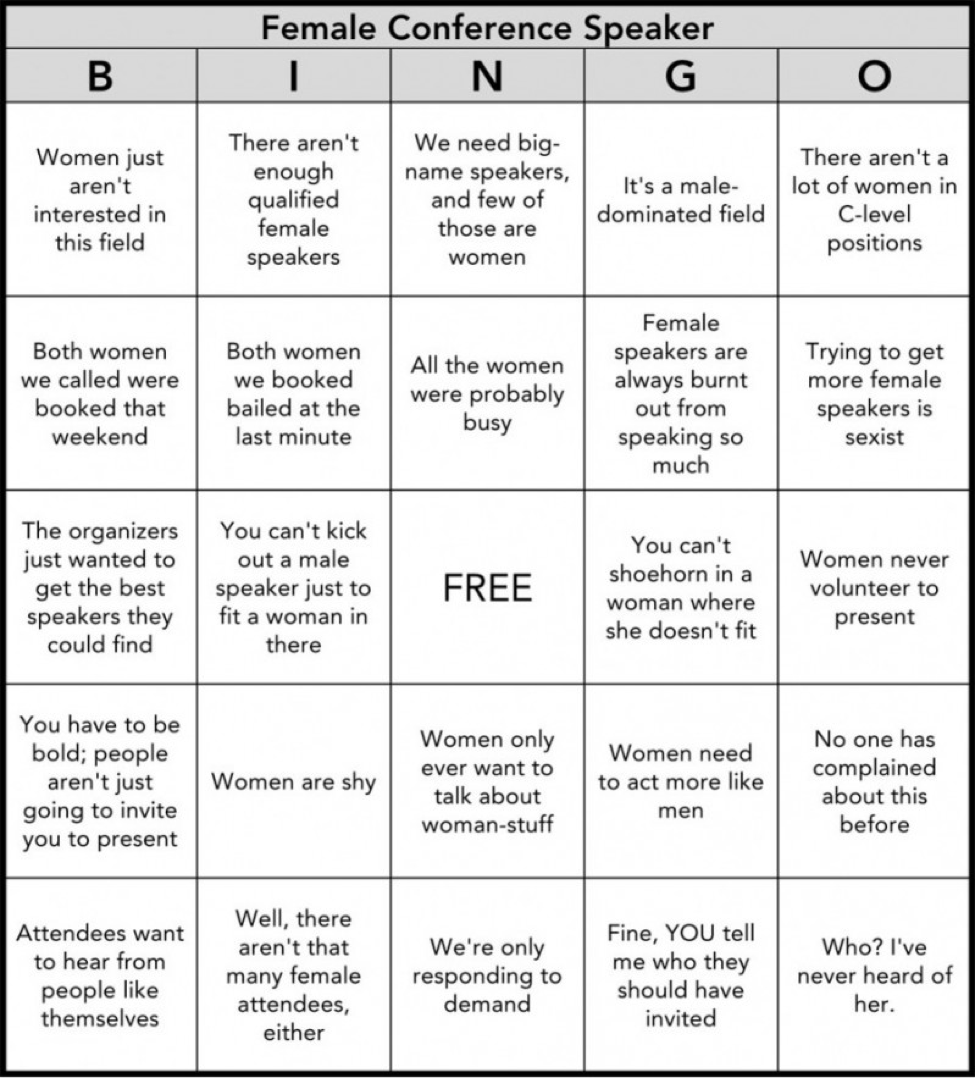
Five years later, this bingo card is still relevant.
What can we do about it?
The most effective way to get more women speakers is to not make this a gender issue but to raise awareness, identify and reduce the barriers to entry. One of the inherent dangers of making it a gender issue, is implementing positive discrimination.
A STEM conference with all women speakers will be equally ineffective as a STEM conference with all men speakers.
We should be striving for equal representation to gather a diverse set of thoughts and ideas.
Here are some thoughts on what organizers, companies and individuals can do to change this situation.
Conference Organizers
Great conferences require great speakers. Every conference organizer wants to put together a diverse, interesting and engaging speaker slate or a panel to have the most memorable event. It takes a lot of time and effort to find the right speakers — speakers who have interesting topics to talk about, speakers who are articulate and can convey their thoughts and opinions while keeping the audience engaged, speakers who are experts in their area and willing to put in the time and effort to prepare and deliver the talk. Men and women can easily fill in these criteria. It is up to the organizers to start looking beyond the usual suspects and put in the extra effort to find the diverse speakers.
Mathematician Greg Martin has used statistical probability to prove that the odds of having zero women speakers at a math conference are next to none.
In his words,
If conference speakers were being chosen by a system that treated gender fairly (which is to say, gender was never a factor at all), then in any conference with over 10 speakers, say, it would be extremely rare to have no female speakers at all — less than 5 percent chance, depending on one’s assumption about the percentage of women in mathematics as a whole.
Turning that statement around, we conclude that any such conference without any female speakers must have come into being in a system that does not treat gender fairly.
Companies and Organizations
In most organizations, the Marketing/PR department gets a number of requests every year for speakers from the conference organizers. If you get a request for sending a speaker, make the effort to find an awesome female employee who would be a great speaker with some mentoring, practice sessions and help with slide reviews. Don’t just go for the usual male employee speaker you have always sent, because it’s convenient. It’s a much larger problem, if you can’t find any awesome female employees in your company.
Also, companies willing to invest in sponsoring a conference should be willing to invest in one (or several) of their female employee’s growth as well. It will take time and effort but for every company talking about diversity and inclusion, here is an action that will actually help move the needle on having more diversity at public conferences.
Besides, it’s good for the company too. Investing more time, focus and resources into encouraging all their employees, women and men, who have the skills and interest to present at conferences increases the number of spokespeople for your company. And it’s so much more than just public speaking, it also develops the employee’s skills to be more confident in meetings, raises more awareness about the company’s brand from diverse perspectives and speaks to the company’s commitment to diversity and inclusion louder than any marketing campaign ever could.
So, look beyond that male employee who fits into the ‘speaker’ persona and has always spoken at every STEM conference your company has sponsored and find that female employee who could be a speaker for your company with just a little help from you. And if you have a female employee who is already a great speaker, do everything to support her to continue down that path.
Speakers
If you are invited to speak at an event, take the time to look at the others speakers and if you don’t see a diverse speaker list, recommend one (or more) of the successful and phenomenal women from your network, who would be a great speaker.
Don’t serve as a panelist at a public conference, if there are no women on the panel.
Be aware of underlying biases that exist and help the conference organizers overcome them.
Getting on stage and speaking in front of a large audience is daunting — encourage the new speakers with your guidance and support.
Having fewer women in tech in the first place, is a large problem by itself, which makes it even more important to showcase several great women speakers at conferences. Removing implicit biases is key to increasing the number of women speakers at public conferences. And the speakers themselves can help by being aware and willing to challenge the status quo.
As for me, I have spoken at number of STEM conferences since then, for the past few years. I still feel I am not a great speaker, I still feel nervous before getting on stage and I still have to spend several weekends preparing for a speech but I know that it’s worth all the effort and the nervousness, if I can encourage even one woman to join a tech career or stay in a tech career. Now, I actively seek out and speak at STEM conferences and also bring in more women speakers to these events.
And I still continue to be amazed at how often I end up being the only female speaker for the day.
Note: Opinions are my own and not related to any of the organizations or institutions that I am or have been associated with.
SOURCE: https://medium.com/@beena./why-i-speak-at-conferences-cd33ca6434c3
Employee voice, or speaking up with information intended to help one’s group, can improve performance, help teams come up with creative solutions, and avoid issues that might hold them back. But new research finds that speaking up only benefits men, and only when they speak up to offer ideas rather than point out problems. The author found that women were not helped by speaking up, regardless of whether it was about ideas or problems. Managers should make a specific effort to encourage women to speak up, taking care to show female employees that their contributions are valued. The author offers a number of ways to do that, including amplifying women’s ideas, making sure women get credit for their contributions, and making a point to call on female employees to hear their thoughts.

We conducted in-depth interviews with 60 female scientists and surveyed 557 female scientists, both with help from the Association for Women in Science. These studies provide an important picture of how gender bias plays out in everyday workplace interactions.
